

- Nootropics support cognition but cannot replace healthy lifestyle habits like sleep and diet.
- Success depends on personalized goals, health background, and careful ingredient evaluation.
- Use systematic tracking and start with well-studied, safe compounds for safety and effectiveness.
Mental fog, scattered focus, and the nagging sense that your brain could perform better are experiences shared by millions. The nootropics market has exploded in response, now valued in the billions, yet the sheer volume of products, claims, and conflicting advice makes choosing wisely feel overwhelming. You deserve a clearer path. This guide cuts through the noise with evidence-grounded, actionable steps so you can approach cognitive supplements with confidence, not guesswork. Whether you are a biohacker optimizing every variable or an aging adult protecting long-term brain health, the same principles apply.
Table of Contents
- Understand what nootropics can and can’t do
- Assess your cognitive goals and needs
- Evaluate ingredients and scientific evidence
- Practical steps for safe and effective nootropics use
- Why a personalized, cautious approach always wins
- Choose science-backed nootropics with NeuroStack
- Frequently asked questions
Key Takeaways
| Point | Details |
|---|---|
| Know your goals | Personal cognitive needs must drive your nootropic choices for best results. |
| Check for credible evidence | Ingredient research and clinical studies help avoid hype and ensure safety. |
| Start low and track progress | Begin with one well-supported supplement and use journaling to monitor effects. |
| Prioritize lifestyle | Diet, sleep, and exercise remain vital for brain health, often more than supplements. |
Understand what nootropics can and can’t do
A nootropic is any substance that supports cognitive function, whether through enhancing memory, focus, processing speed, or protecting neurons over time. The term covers a wide spectrum, from well-researched compounds like lion’s mane mushroom and bacopa monnieri to synthetic racetams and everything in between. Understanding the biology behind them helps you separate genuine tools from marketing noise.
Most nootropics operate through a handful of core mechanisms. Nootropics work via neurotransmitter modulation, neuroprotection, and anti-inflammatory pathways, and how well they work depends heavily on your baseline health and specific goals. For example, a compound that raises acetylcholine levels may sharpen focus in someone with low cholinergic tone but produce little noticeable effect in someone already optimized.
Here is what nootropics can realistically support:
- Sustained attention and reduced mental fatigue during cognitively demanding tasks
- Stress modulation through adaptogenic pathways, which indirectly supports memory consolidation
- Neuroprotection against oxidative stress, particularly relevant for aging adults
- Mood stability, which often translates to better cognitive output
- Incremental improvements in learning speed when paired with quality sleep
“The strongest predictor of cognitive performance is not which supplement you take, but how consistently you sleep, move, and eat.”
What nootropics cannot do is replace foundational lifestyle habits. Harvard Health cautions that there is a lack of solid proof for brain supplements in healthy adults, and that lifestyle interventions remain the priority. No pill compensates for chronic sleep deprivation or a nutrient-poor diet.
Pro Tip: Think of nootropics as a 10 to 15 percent amplifier on top of an already solid foundation. If the foundation is weak, the amplifier has nothing meaningful to boost. Explore how mental performance boosters interact with lifestyle factors before committing to a stack.
Incremental gains are the realistic expectation. You may notice sharper focus during a demanding work session or slightly faster recall after weeks of consistent use. Dramatic overnight transformations are a red flag, not a feature.
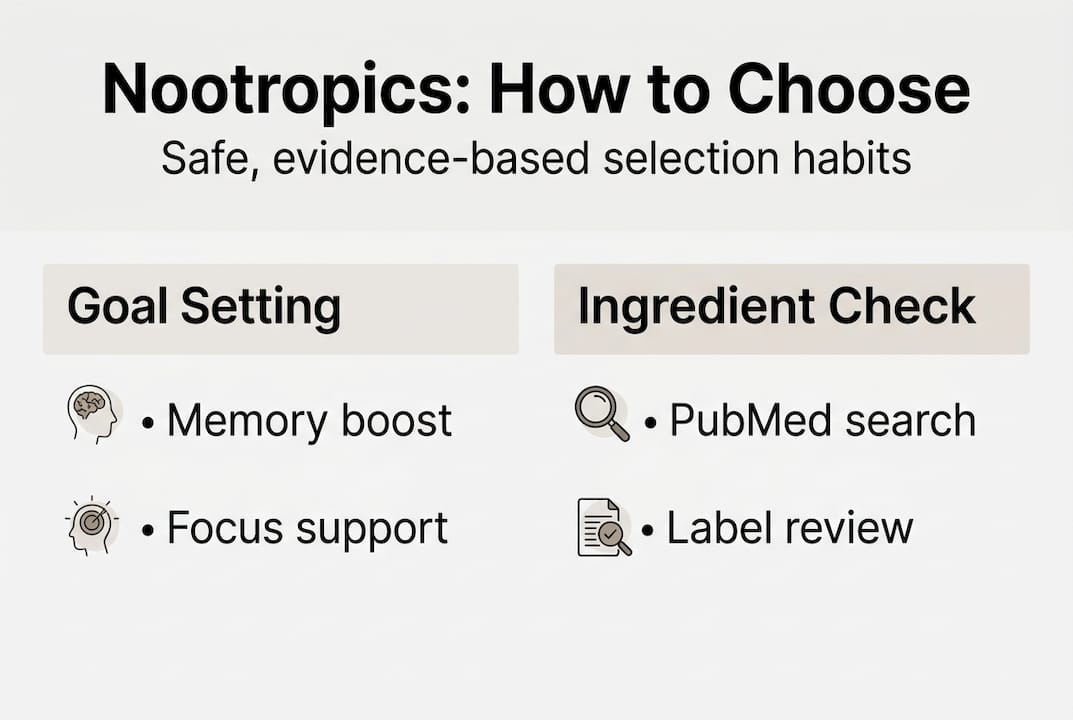
Assess your cognitive goals and needs
Personalization is the single most important factor in nootropic success. Two people can take the same supplement and experience completely different outcomes because their goals, health backgrounds, and neurochemistry differ. Before you spend a dollar, get specific about what you actually want to improve.
Here is a structured way to clarify your cognitive priorities:
- Define the primary problem. Is it difficulty sustaining focus for hours? Poor short-term memory? Brain fog after meals? Low motivation? Each points to different mechanisms and therefore different ingredients.
- Assess your health background. Age, existing conditions, medications, and known sensitivities all shape which compounds are appropriate. Some nootropics interact with blood thinners or thyroid medications, for instance.
- Examine your lifestyle baseline. Are you sleeping seven to nine hours consistently? Is your diet rich in omega-3s and B vitamins? Deficiencies here can mimic cognitive decline and may be correctable without supplements.
- Set a time horizon. Some nootropics show effects within hours (L-theanine, caffeine combinations). Others, like bacopa monnieri, require eight to twelve weeks of consistent use before measurable benefits appear.
- Decide on your risk tolerance. Beginners should start with well-studied, single-ingredient options. Experienced users may experiment with more complex formulations.
Nootropics effectiveness is goal-dependent and should be tailored to individual needs rather than chosen based on popularity or trending content. A supplement dominating biohacker forums may be completely irrelevant to your specific bottleneck.

Pro Tip: Write down your top two cognitive complaints and your top two goals before researching any product. This simple filter eliminates 80 percent of the market immediately and keeps your decision-making grounded. Understanding performance nutrition principles can also reveal whether nutritional gaps are driving your symptoms before you add any supplement.
One-size-fits-all stacks are a marketing convenience, not a scientific recommendation. Your cognitive needs are specific, and your supplement choices should reflect that specificity.
Evaluate ingredients and scientific evidence
Once you know your goals, the next challenge is reading labels critically. The supplement industry is largely self-regulated, which means the burden of verification falls on you as the consumer.
| Ingredient | Evidence level | Primary benefit | Typical dose |
|---|---|---|---|
| Lion’s mane mushroom | Moderate | Nerve growth factor support | 500 to 1000 mg daily |
| Bacopa monnieri | Strong | Memory consolidation | 300 to 450 mg daily |
| L-theanine | Strong | Focus, calm alertness | 100 to 200 mg daily |
| Citicoline | Strong | Attention, neuroprotection | 250 to 500 mg daily |
| Ginkgo biloba | Mixed | Circulation, memory | 120 to 240 mg daily |
| Phosphatidylserine | Moderate | Memory, stress response | 100 to 300 mg daily |
Watch for these red flags on any label:
- Proprietary blends that hide individual ingredient doses behind a total weight, making it impossible to verify efficacy
- Underdosed compounds where the listed amount falls well below the dose used in clinical trials
- Unrealistic claims such as “boost IQ by 40 percent” or “reverse cognitive decline in 30 days”
- No third-party testing certification from organizations like NSF, USP, or Informed Sport
- Excessive ingredient lists with 20 or more compounds, most of which are present in trace amounts
Harvard Health urges focusing on lifestyle interventions due to insufficient supplement evidence, which is a useful reminder that even well-formulated products are adjuncts, not solutions. Review longevity supplement evidence to understand which compounds have genuine long-term data behind them.
To find credible research, use PubMed or Google Scholar and search for the ingredient name plus “randomized controlled trial” or “systematic review.” Prioritize human studies over animal or in-vitro research. Also check evidence-based recovery steps for context on how recovery and cognitive performance intersect.
Practical steps for safe and effective nootropics use
Selecting a promising nootropic is only half the work. How you introduce it, track it, and adjust matters just as much as what you choose.
| Tracking method | Best for | Effort level | Data quality |
|---|---|---|---|
| Paper journal | Daily mood and focus notes | Low | Subjective |
| Cognitive apps (e.g., Cambridge Brain Sciences) | Objective performance metrics | Medium | High |
| Wearables (HRV, sleep tracking) | Physiological correlates | Medium-High | High |
| Spreadsheet log | Dose, timing, and effects | Low-Medium | Moderate |
Follow these steps when introducing any new nootropic:
- Consult a healthcare provider first, especially if you take medications or have existing health conditions. This is non-negotiable, not optional.
- Start with one compound at a time. Introducing multiple variables simultaneously makes it impossible to identify what is working or causing side effects.
- Begin at the lowest effective dose listed in clinical research and hold that dose for at least two to four weeks before adjusting.
- Log daily observations including energy, focus quality, sleep, mood, and any physical symptoms. Be specific and consistent.
- Evaluate after four to eight weeks with clear criteria. If you cannot identify a measurable change, the compound may not be right for your goals.
“The most common mistake is stacking five compounds in week one. You end up with a confusing mix of effects and no idea what is actually doing anything.”
Efficacy and safety depend on using the right dose and monitoring effects carefully, which is why systematic tracking is not optional for anyone serious about cognitive optimization. Quick dose escalation and premature stacking are the two most common mistakes that turn a promising experiment into a frustrating one.
Why a personalized, cautious approach always wins
The biohacking community tends to celebrate complexity. Multi-compound stacks, precise timing protocols, and exotic ingredients make for compelling content. But the most consistent cognitive gains we observe come from people who do the boring work first: fixing sleep, addressing nutritional gaps, managing stress, and then layering in one well-chosen supplement.
Most experts agree that lifestyle interventions outperform supplements in healthy adults, and that finding holds across age groups. The aging adults who report the best outcomes are not the ones with the most complex stacks. They are the ones who track carefully, adjust based on real data, and resist the urge to chase every new compound.
Trial and error, done systematically, beats following trends every time. The supplement that works brilliantly for a 28-year-old male athlete may do nothing for a 55-year-old woman managing perimenopause. Respecting that difference is not a limitation. It is the whole strategy. Explore brainpower boosters with this lens and you will make far better decisions than anyone chasing the next viral stack.
Choose science-backed nootropics with NeuroStack
Applying these principles is easier when the products you choose are built around the same standards. NeuroStack offers premium nootropic supplements that are plant-based, third-party tested, and formulated around ingredients with credible research support. Every product is designed with transparency at its core, so you can verify exactly what you are putting into your body. Browse the full nootropic ingredients library to match compounds to your specific goals, and review the complete ingredient transparency page to see sourcing and testing details. NeuroStack is built for people who ask the right questions before they buy.
Frequently asked questions
What are the safest nootropics to start with?
Single-ingredient options with strong safety records, such as L-theanine or citicoline, are ideal starting points. Always consult a healthcare professional, since right dose and monitoring are essential even with well-tolerated compounds.
Do nootropics really work for healthy adults?
The evidence for cognitive benefits in healthy adults is limited overall. Lack of solid proof for brain supplements means sleep, diet, and exercise remain more reliable tools for most people.
Can I combine multiple nootropics safely?
Start with one compound at a time and monitor carefully before adding anything else. Right dose and monitoring become even more critical when combinations are involved.
How do I know if a nootropic is working?
Use a consistent tracking method, whether journaling or a cognitive app, and set clear benchmarks before you start. Careful monitoring is the only reliable way to distinguish real effects from placebo.


0 comments