

- Supplements work best when addressing specific deficiencies over 3 to 6 months.
- Testing for deficiencies guides targeted supplement use, avoiding unnecessary intake.
- Quality and individual needs are crucial; personalized approach ensures safe, effective results.
Most people expect supplements to work like a light switch. Take a capsule, wait two weeks, watch your hair thicken. That’s not how biology operates. Real, visible improvement in hair and nail health depends on correcting specific deficiencies, choosing ingredients backed by clinical evidence, and giving your body enough time to respond. Biotin, collagen, zinc, and vitamin D each play distinct roles, but only under the right conditions. This guide breaks down the science behind which supplements actually work, when they’re worth taking, and how to use them without wasting money or risking side effects.
Table of Contents
- How supplements impact hair and nail health
- Key evidence-backed supplements and their effects
- When supplements are most effective: Deficiency, conditions, and timing
- Risks, safety, and how to choose supplements wisely
- Our take: Why supplement results hinge on individual needs
- Next steps: Explore proven supplement solutions
- Frequently asked questions
Key Takeaways
| Point | Details |
|---|---|
| Deficiency matters most | Supplements make the biggest impact when correcting confirmed vitamin or mineral deficiency. |
| Patience is essential | Visible improvements in hair and nails happen gradually, usually over 3–6 months. |
| Safety first | Test for deficiencies and choose third-party tested supplements to maximize benefit and reduce risks. |
| Individualized supplementation | Tailor supplement choices to your personal needs, health data, and professional advice. |
| Diet is foundational | A nutrient-rich diet supports hair and nails and should be prioritized before supplementation. |
How supplements impact hair and nail health
Hair and nails are made of structural proteins, primarily keratin, and they depend on a steady supply of micronutrients to grow properly. When those nutrients run low, the body redirects resources away from non-essential tissue like hair follicles and nail beds. That’s when you start seeing breakage, thinning, and slow growth.
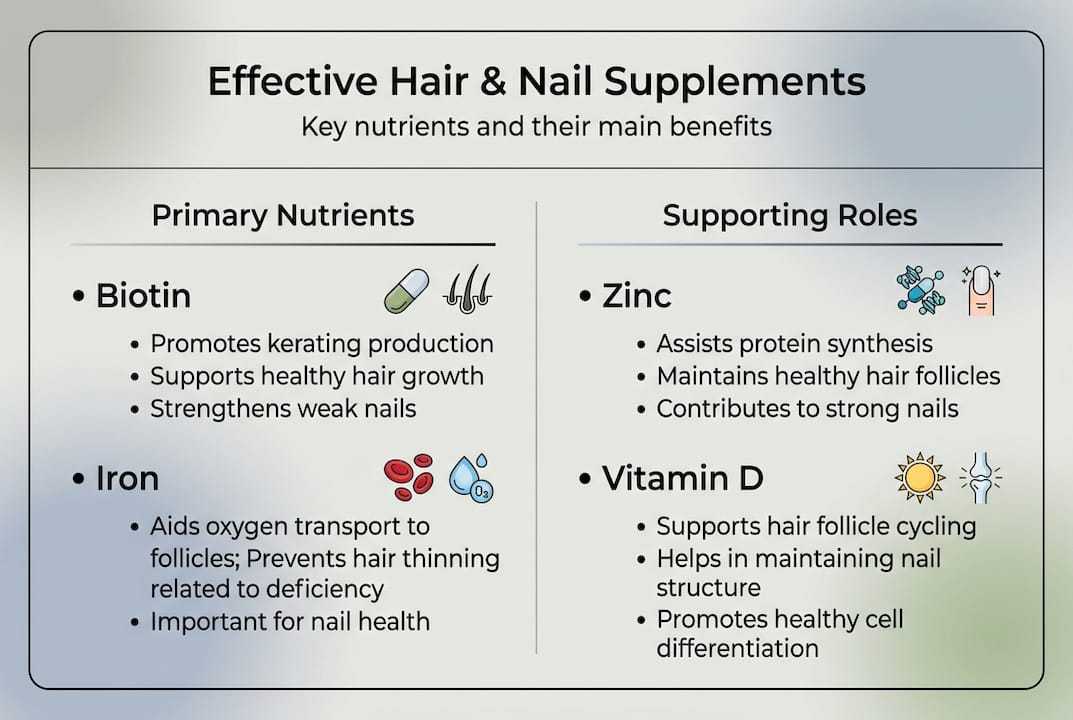
The main nutrients involved include biotin, collagen, zinc, silica, vitamin D, iron, and omega-3 fatty acids. Each one plays a specific role:
- Biotin supports keratin protein synthesis, the structural backbone of both hair and nails
- Collagen and silica provide structural support to the dermis layer surrounding hair follicles
- Zinc and iron regulate cell repair and oxygen delivery to follicle tissue
- Vitamin D activates hair follicle cycling, influencing whether follicles stay in the growth phase
- Omega-3 fatty acids reduce scalp inflammation that can disrupt follicle function
Deficiency in any of these creates visible problems. Low iron causes diffuse shedding. Low vitamin D is linked to follicle dormancy. Zinc deficiency leads to brittle, slow-growing nails. The good news is that supplementation is most effective precisely in these cases.
“Biotin contributes to maintenance of hair and nails, and is effective mostly in deficiency and brittle nail syndrome.”
For people without a confirmed deficiency, results from single-ingredient supplements are modest at best. Collagen and zinc support normal hair, nails, and skin structure, but the benefit is most pronounced when baseline levels are low.
One important timing reality: most supplements require 3 to 6 months before visible changes appear. Hair grows roughly half an inch per month, and nail turnover is even slower. Patience isn’t optional here. It’s built into the biology.
| Nutrient | Primary role | Visible deficiency sign |
|---|---|---|
| Biotin | Keratin synthesis | Brittle nails, hair loss |
| Iron | Oxygen delivery to follicles | Diffuse shedding |
| Vitamin D | Follicle cycling | Dormant follicles, thinning |
| Zinc | Cell repair | Slow nail growth, breakage |
| Collagen | Structural dermis support | Weak nails, dull hair |
| Omega-3 | Scalp inflammation control | Dry scalp, follicle disruption |
For those considering multi-ingredient supplements, the combined approach often addresses multiple pathways at once, which can be more efficient than stacking individual products.
Key evidence-backed supplements and their effects
Not all supplements carry equal evidence. Some have robust clinical trial data. Others rely on observational studies or anecdotal reports. Here’s how the main players compare.
Biotin is the most studied supplement for brittle nails. At doses ranging from 2.5 to 10 mg daily, biotin improves nail thickness and reduces splitting after 3 to 6 months of consistent use. For hair, it’s most effective in people with confirmed deficiency or certain genetic conditions affecting biotin metabolism.
Collagen peptides are widely studied for skin and nail support. Hydrolyzed collagen is absorbed more readily than whole collagen protein, and several trials show improvements in nail brittleness and growth rate after 4 months of daily use.

Multi-ingredient formulas like Nutrafol combine ingredients such as ashwagandha, saw palmetto, marine collagen, and biotin. Multi-ingredient supplements improve hair density and are well-tolerated according to a network meta-analysis of randomized controlled trials. Pumpkin seed oil has also shown clinical evidence for improving hair density, particularly in androgenetic alopecia.
| Supplement | Best evidence for | Typical dose | Timeline |
|---|---|---|---|
| Biotin | Brittle nails, deficiency | 2.5 to 10 mg/day | 3 to 6 months |
| Collagen peptides | Nail brittleness, skin | 5 to 10 g/day | 4 months |
| Pumpkin seed oil | Hair density (AGA) | 400 mg/day | 6 months |
| Zinc | Deficiency-related loss | 8 to 11 mg/day | 3 months |
| Vitamin D | Follicle cycling | 1000 to 2000 IU/day | 3 to 6 months |
Vitamin D, zinc, iron, and omega-3s play strong supporting roles, particularly for people with lab-confirmed low levels. Silica, found in horsetail extract, supports collagen formation and nail hardness, though the evidence base is smaller.
Pro Tip: Before investing in a premium multi-ingredient formula, consider testing for deficiencies first. Knowing your actual nutrient gaps lets you choose targeted products instead of broad-spectrum formulas that may include ingredients you don’t need.
One often-overlooked detail: supplement quality varies significantly across brands. Third-party testing for purity and potency is a non-negotiable standard when selecting any product.
When supplements are most effective: Deficiency, conditions, and timing
Supplements aren’t universally necessary. For most people eating a varied diet with adequate protein, eggs, nuts, and leafy greens, baseline nutrient levels are sufficient for normal hair and nail function. Supplementation delivers the clearest benefit in specific scenarios.
Supplements show the greatest effect for individuals with recognized conditions such as androgenetic alopecia (AGA), brittle nail syndrome, or lab-confirmed nutrient deficiency. Outside these contexts, results are less predictable.
Here’s a practical approach to determining whether supplements are right for you:
- Audit your diet first. Track protein, iron-rich foods, and biotin sources like eggs and almonds for two weeks. Many people are closer to adequate than they think.
- Request lab tests. Ask your doctor for a panel covering ferritin, vitamin D, zinc, and thyroid function. These are the most common deficiencies linked to hair and nail problems.
- Consult a dermatologist. If you’re experiencing significant shedding or nail changes, a professional assessment rules out underlying conditions that supplements won’t fix.
- Start one supplement at a time. Isolating variables makes it easier to identify what’s actually working.
- Track progress with photos. Monthly photos of hair density and nail length give you objective data instead of relying on perception.
“Results take 3 to 6 months; prioritize diet before supplements.”
Pro Tip: If you’re unsure where to start, testing for biotin, iron, and vitamin D gives you a clear picture of where supplementation will actually move the needle.
Patience is the most underrated factor. Hair follicles cycle through growth and rest phases over months, not weeks. Stopping a supplement after one month because you don’t see results is one of the most common mistakes people make.
Risks, safety, and how to choose supplements wisely
Supplements feel low-risk because they’re sold over the counter. But there are real considerations worth knowing before you start.
Biotin and lab test interference is the most clinically significant issue. High-dose biotin interferes with lab tests, including thyroid panels and cardiac troponin assays, by disrupting the biotin-streptavidin binding used in many immunoassays. This can produce falsely elevated or falsely low readings, leading to misdiagnosis. If you’re taking biotin at doses above 5 mg daily, stop supplementation at least one week before any blood work.
Other risks to be aware of:
- Acne flares: High-dose biotin can trigger breakouts in acne-prone individuals, likely by competing with pantothenic acid (vitamin B5) for absorption
- Iron overload: Supplementing iron without confirmed deficiency can cause gastrointestinal distress and, in severe cases, organ damage
- Drug interactions: Zinc can interfere with antibiotic absorption; omega-3s at high doses may affect blood clotting
- Allergen exposure: Many collagen supplements are derived from marine or bovine sources, which can be problematic for people with specific food allergies
“Test for deficiencies and consult your doctor before starting supplements, especially for at-risk groups.”
Pro Tip: When choosing supplement ingredients, look for products with a Certificate of Analysis from an independent lab like NSF International or USP. This confirms what’s on the label is actually in the bottle.
The safest strategy is to treat supplements as a targeted intervention, not a daily insurance policy. Use them to correct a specific gap, monitor your response, and reassess with your healthcare provider every few months.
Our take: Why supplement results hinge on individual needs
The supplement industry thrives on the idea that more is better. Buy the premium formula, take it every day, and your hair will transform. That framing sells products, but it doesn’t reflect how nutrients actually work in the body.
The honest reality is that supplements work best when they’re solving a real problem. A person with low ferritin who starts an iron supplement may see meaningful hair regrowth within six months. Someone with normal iron levels taking the same supplement will likely see nothing, and may create new problems in the process.
What most people and even many wellness influencers overlook is that personalized data matters more than marketing claims. Lab results, dietary habits, and a conversation with a dermatologist or physician will always outperform a one-size-fits-all approach. Exploring unpacking supplement research alongside your own health data is a far more reliable starting point than following trends.
Combining proven supplementation with a genuinely nutrient-rich diet, adequate protein, and consistent sleep creates the conditions where these ingredients can actually do their job. Supplements fill gaps. They don’t replace foundations.
Next steps: Explore proven supplement solutions
If you’re ready to move beyond generic products, here’s where to start with proven solutions. NeuroStack’s product line is built around science-backed ingredients designed to support hair, skin, nail, and overall wellness goals. Every product is third-party tested for purity and formulated with transparency in mind, so you know exactly what you’re putting into your body.
Browse premium supplements that align with your specific health goals, and explore the full breakdown of nature’s best nutrients to understand which ingredients are most relevant to your needs. Whether you’re addressing a confirmed deficiency or looking to optimize your current routine, the right starting point is always informed and intentional.
Frequently asked questions
How long does it take for supplements to impact hair and nail growth?
Most supplements take 3 to 6 months to show visible improvement, especially when addressing deficiencies. Combining supplementation with balanced nutrition speeds up the process.
Should I get tested for deficiencies before starting supplements?
Yes. Testing for deficiencies prior to starting hair and nail supplementation ensures you’re targeting a real gap and not supplementing unnecessarily. Ask your doctor for a ferritin, vitamin D, and zinc panel.
Are high doses of biotin safe for everyone?
High-dose biotin can interfere with lab tests and cause acne in some individuals. Always consult your doctor before taking doses above 5 mg daily.
What are the most effective supplements for brittle nails?
Biotin at doses of 2.5 to 10 mg daily is well-supported for brittle nail syndrome, particularly in deficiency cases where it improves nail thickness and reduces splitting.
Can diet alone improve hair and nail health?
A nutrient-rich diet with eggs, nuts, and fish often prevents deficiency and supports healthy hair and nails without supplementation. Supplements are most useful when diet alone isn’t closing the gap.
Recommended
- Ingredients for Health: Discover Nature’s Best Nutrients for Wellness – NeuroStack
- Top mental performance boosters list for focus and brainpower – NeuroStack
- Longevity Supplements Science: Effective Evidence-Based Insights – NeuroStack
- Mushroom nootropics: science, benefits, and how to choose – NeuroStack


0 comments